Active Isolated Stretching Exercises from N.Y

Active Isolated Stretching Exercises

Eight exercises from Jim and Phil Wharton

Below are 8 active isolated stretches from the father/son team of Jim and Phil Wharton. The underlying theory behind A.I.S is that if a muscle is stretched too far, too fast, or for too long, it elicits a protective action known as the myotatic reflex, causing it to automatically and ballistically recoil in an attempt to prevent the muscle from tearing. This occurs about three seconds into a stretch. 

Therefore, A.I.S  practitioners hold a stretch for only two seconds, before the myotatic reflex kicks in, then relax and repeat 10 times. Using this technique, the muscles exhibit a greater range of motion over the course of each set of stretching repeats.

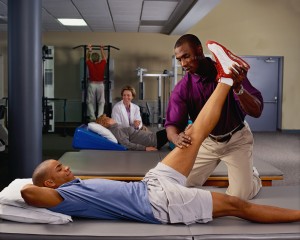
The other key to A.I.S is to contract the opposing muscles to allow the target muscle to relax. For example, when stretching the hamstrings, the quadriceps muscles on the front of the leg are contracted, relaxing the hamstrings and making them more susceptible to stretching. A runner would lie on his back, lift his leg by using the muscles on the front of the leg, then stretch the hamstring by lightly pulling the leg back to the point of tightness for two seconds, then releasing.

This brings up the “assisted” aspect of A.I.S The muscle is coaxed through its last few degrees of motion either by a partner, or more commonly, by the use of an eight-foot length of rope that is wrapped around the foot or leg in various ways depending on the direction of the stretch.

For more on stretching, see The Wharton’s Way, or visit www.aistretch.com.

STRETCH #1: SINGLE LEG PELVIC TILT 

Lie on your back, bending your nonexercising knee. Bend your exercising knee and place your hands behind your knee/thigh. Using your abdominals and hip flexors, lift your exercising leg toward your chest until you can go no farther. Aim your knee toward your armpit, gently assisting your leg at the end of the stretch with your hands, but do not pull.

STRETCH #2: BENT LEG HAMSTRING

Lie on your back with both knees bent and your feet flat on the floor. Make a loop from the rope and place the foot of the leg you’re exercising into the loop. Lift your leg until your thigh is perpendicular to the floor. Grasp the ends of the rope with one hand and place the other on top of the thigh of the exercising leg to stabilize it. Gradually extend your leg by contracting your quadriceps, causing your foot to rise to the ceiling. The goal is to lock your knee and have your foot at high noon. You may have to lower the angle of your leg from the hip at first. Use the rope for gentle assistance at the end of the stretch, but do not pull the leg into position.

STRETCH #3: STRAIGHT LEG HAMSTRING

Lie on your back. Begin with your non-exercising knee bent and with that foot flat on the floor. Make a loop from the rope and place the foot of the leg you’re exercising into the loop, locking the knee so the leg is extended straight out. From the hip and using the quadriceps, lift your leg as far as  you can, aiming your foot toward the ceiling. Grasp the ends of the rope with both hands and “climb” the rope, keeping slight tension on it. Use the rope for gentle assistance at the end of the stretch, but do not pull the leg into position.


STRETCH #4: GASTROCNEMIUS

Sit with both legs straight out in front of you. Loop the rope around the foot of your exercising leg (still straight). From your heel, flex your foot back toward your ankle, using the rope for a gentle assist at the end of the movement.


STRETCH #5: LATERAL TRUNK FLEXORS

Stand with both arms at your sides. Raise one arm, placing that hand behind your head with the elbow pointed away from your body. Bend at the waist so that the arm that is straight is lowered down the side of the leg toward the knee and lower leg. This stretch can be modified by leaning slightly forward or backward before bending at the waist.


STRETCH #6: TRUNK EXTENSORS

Sit with your back straight, your knees bent, your feet resting on your heels, and your toes pointing slightly up. Tuck your chin down, contract your abdominal muscles to pull your body forward. Grasp the sides of the lower legs with your hands to gently assist at the end of the stretch. To modify this for a deep lower back stretch, bring your heels closer to your body.


STRETCH #7: HIP ADDUCTOR

Lie on your back with both legs extended straight out, looping the rope around the inside of the ankle, then under the foot, of the exercising leg, so the ends of the rope are on the outside. Lock that knee and rotate the other leg inward slightly. From your hip and using your abductors, extend your exercising leg out from the side of your body, leading with your heel. Keep slight tension on the rope and use it for gentle assistance at the end of the stretch. Do not pull the leg into position.

STRETCH #8: QUADRICEPS

Lie on your side with your knees curled up against your chest (in a fetal position). Slide your bottom arm under the thigh of your bottom leg and place your hand around the outside of your foot, or use a looped rope. Reach down with your upper hand and grasp the shin, ankle or forefoot of your upper leg. Keep your knee bent and your leg parallel to the surface you’re lying on. Contract your hamstrings and gluteus maximus, and move the upper leg back as far as you can, using your hand to give a gentle assist at the end of the stretch.


Active Isolated stretching with Dr, Jeffrey P. Haggquist, DO

Aaron Mattes continues to refine his thinking and hone his work. Active Isolated Stretching and Strengthening (AIS) – The Mattes Method – is a program for everyone!

Over forty years ago, Aaron Mattes began to develop exercise protocols to increase flexibility and strengthen specific muscle groups. His combined flexibility and strength training – AIS – employs physiologically principled exercises that that are systemic, progressive, and unsurpassed in effectiveness when delivered in an instructive and positively reinforcing environment.

Together they comprise a complete package for everyday wellness, sports training or rehabilitation.

The Mattes Method employs full range of motion movements to contract and strengthen targeted muscles while at the same time stretch the opposing (antagonist) muscles. This simultaneous strength and flexibility training develops potency in the newly-established range of motion, making it functional and safe, while balancing soft tissue tone across the joint.

Mattes exercises promote range of motion, restore or develop brain-muscle connectivity, and increase muscle strength, as well as that of all other soft tissues, including fascia, tendons and ligaments. In fact, as a strength exercise, AIS promotes healthy bones.

I have known Aaron Mattes for more than twenty-five years. He has been my mentor, colleague, and friend. I believe in his work and the effectiveness of its results. I became a physician with Aaron’s encouragement, knowing that I would have AIS, one of the most effective therapeutic tools ever developed, in my toolbox. It has been my dream to bring AIS to the medical setting.

In my clinic, QuistMD-The Flexibility, Sports, and Rehabilitation Clinic in Washington, DC, I use AIS with my patients to treat a range of musculoskeletal conditions – from multiple sclerosis to scoliosis, from carpal tunnel syndrome to lower back problems – to relieve pain and facilitate the healing process. I’ve been impressed with the effectiveness of AIS for neuromuscularskeletal re-conditioning to bring about movement in limbs and digits damaged by stroke. I use it with my hyper mobility patients, to strengthen areas that are strained from compensation patterns.

At QuistMD, we rehabilitate after surgery using AIS with strong outcomes, but some of the most impressive results using AIS have been in rehabilitation. Using AIS to prepare for surgery, many patients have realized substantial benefits:


*Average recovery time after surgery is generally 50% of the predicted timeframe,

*pre-habilitation facilitates alleviation of pain symptoms, and

*in some cases, conditions have improved to the point of making surgery unnecessary.

I also treat lots of athletes, as does Aaron, who wants to prevent or recover from an injury, or who wants to enhance their performance. We have rowers, runners, soccer and lacrosse players, cyclists, pitchers, and tri-athletes. As an athlete myself, I know how important AIS is for me, before and after training and events.

But AIS can do even more! AIS is an approach to the body, which, when employed with adjunctive methods to address specific issues, can offer a complete approach to health and well-being – the AIS approach.

Aaron Mattes is moving AIS forward. Having long dreamed of a national certification program for AIS practitioners. Aaron has delegated the necessary tasks for its development. The program will create a professional path for AIS practitioners, with a standardized education and training program, leading to multiple levels of practitioner certification.

Aaron also supports efforts to conduct much-needed research, to build the evidence base for AIS. One of the most important research imperatives is demonstrating the efficacy of the two-second hold. My clinic has undertaken a promising, but small, pilot, study, but much more data is needed, accompanied by the necessary resources to conduct large-scale trials. In addition, I have begun a formal clinical research study to determine the effectiveness of using AIS in combination with manual therapies to treat cervical strain and sprain in the rehabilitation setting. Because effective stretching is the foundation of flexibility training, defining it may change the way we develop flexibility programs.

AIS is growing and I’m excited to be part of the next generation of leadership! I hope all of you who read this book and learn Aaron’s craft will dedicate your practice of it to his experience, knowledge and foresight these many years ago. It is my belief that AIS can and will change medicine.

Dr, Jeffrey P. Haggquist, DO

What is Shoulder Instability?

Dr Christopher Dodson, shares some of his knowledge on shoulder instability:

The term “shoulder instability” constitutes a spectrum of disorders that includes dislocation, subluxation and laxity. When the shoulder slips partially out of joint, this is called subluxation. A dislocated shoulder occurs when the shoulder comes completely out of joint. There are some people who have a capsule that is a little bit too loose.
Such individuals are described as having ligamentous laxity or being “lax”. It should be noted that laxity is a variation of normal whereas instability is not. Therefore, patients can have baseline laxity and then suffer an injury which leads to instability.

Read More

Stretch therapy helps for neck pain.

Neck pain is a term used to widely describe a number of different conditions that you can have in your neck. Ranging from Cervical spondylosis, whiplash, strain, herniated disc right through to arthritis.

Most people experience neck pain in some point of their lives, and frequently they do not have the answers to deal with this problem appropriately and effectively resulting in them having to experience pain for a much longer period of time then was necessary.

Most neck pain starts with an insidious onset, in other word symptoms that have come on rather gradually. starting with an uncomfortable pain in the upper shoulder area after a nights sleep or the day after you have been doing some unusual activities.

Read More