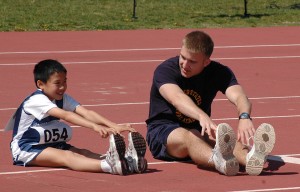
 To Stretch or Not To Stretch?
A debate written by Roger Robinson and Candace Karu
Not To Stretch! “Did it help my running? Not a scrap.”
And on the other side:
To stretch! ” Stretching can help us extend the life of our muscles, tendons and fascia, helping us maintain flexibility and keeping injuries at bay. Stretching can keep many of us running longer and stronger. Frankly, I’d do just about anything to achieve that goal. Stretching seems a small price to pay.”
Read this and find out what is more important too you, doing boring things like brushing your teeth, combing your hair and cleaning your shoes are all necessities in our social environment, so on the same note would stretching be a boring but yet necessary thing to do in the sport and injury environment?
It gets even better, you can now simply go and see an expert to do all your stretching for you!, precisely, accurately and right to the points that you needed it most.
First up: Roger Robinson
NOT TO STRETCH:
I’m a skeptic about stretching. Like every runner, I want to be fast, strong, agile, and pain free; I want to eliminate injuries, reduce muscle soreness, and feel at least part-Kenyan. For many years I did get near these goals. But not by stretching.
Yes, I did my share of pushing against trees and lampposts, heaving my foot up on fence rails and car hoods, using every unseen elevator ride for that addictive surreptitious twangle of the muscle fibers. I knew how stretching would balance the uneven development of a runner’s calf muscles, quads and hamstrings. At train stations and bus stops I stood holding one foot to the buttock like a wobbly heron, or stood with toes on the curb to practice heel drops, or bowed over a forward-lunging leg like a member of some strange religious sect, facing Eugene, or slumped with dangling arms to touch my toes, convincing onlookers that I was about to pass out and require CPR.
Did it help my running? Not a scrap.
I know it’s close to heresy, but I believe stretching is a waste of time and energy unless you want to put your leg up behind your ear like a cat. I have four ways of justifying my aversion.
I am a runner, not a limbo dancer. In a race I need my leg muscles to work fast, powerfully and often. Stretching teaches them to work slowly, flexibly and once. I need them to move me forward, and every tiny fraction of an inch per stride is significant to my result. Stretching encourages them to move sideways, which could even slow down my final time. I need them to be efficient within the requirements of a highly specific and purposeful range of motion. Stretching encourages them to go outside that range. Running, even a marathon, is intense and mobile. Stretching is leisurely and static. Running is work (and work is heat). Stretching isn’t.
In my peak running days, with a full career outside the sport, I was leading a crowded life that never gave me enough time for the running I ideally wanted to do. To those who asked me about stretching, I used to say simply that if I could find 15 minutes a day to stretch, I’d rather spend that time running. Even now, in my declining years, I know people who spend as much time stretching as they do on their feet in the park. I’d rather be running.
Stretching can injure you. I am far from the only runner I know who has been hurt by stretching. In my case, when I was having trouble with an Achilles tendon, I was advised to do “stairs drops.” Instead of giving me a flexuous, pain-free Achilles, it tore tissues behind the knee and put me out for a year. I could have injured the Achilles three times at less cost in time. Yes, no doubt I did my stair stretches too hard, too far, too soon, too often—so they said. But that’s what runners are like. If stretching is so dangerous, why risk it? Even if I had devoted long hours to extending ever so slowly, ever so gently, wearing that bit of stair carpet to the scrim, would the benefit to my running have justified so much time invested? Is there proof that a stretched Achilles tendon is less liable to injury? Why, when most injuries there come from impact or pressure from the shoe?
Running is interesting, stretching is boring. Running gives a sense of fulfillment, achievement, even transcendence. Stretching gives a sense of being stretched. Life is too short for boring things. The only time stretching was ever amusing was when the cat used to join me on the floor, rolling and twirling and arching her furry gray back. She was a very satirical cat.
I am not alone. The online “Peak Performance Newsletter,” Number 175, summarized a recent research review by Australian exercise physiologists Mick Wilkinson and Alun Williams, published in the British Medical Journal, which finds no statistical link between stretching and injury prevention and no identifiable benefit for runners from stretching. From their statistical data Wilkinson and Williams conclude that the average runner would have to stretch non-stop for 23 years to prevent one injury. Their physiological argument is that encouraging rotational movement, such as hip flexibility, “will not only contribute nothing at all to the main [forward] effort but will also waste precious energy in neutralizing these unhelpful rotary movements.” Pete Pfitzinger ventured into the same territory in the June 2004 issue of Running Times: “Runners who are more economical tend to be relatively inflexible. Reduced flexibility may increase the ability of the muscles to store and return energy, or increase leg stability.”
The flexibility a runner needs is running specific. If I wrote a book and called it SF (specific flexibility) it might become a cult. You get it by making your running varied and natural. Instead of bashing every mile on the same unyielding blacktop or concrete road surface, run on trails and tracks, hills and hollows, soggy mud, sticky clay, and springy grass, splash through puddles and skitter over stones and struggle through sand—whatever you can find that is varied and natural. Running at speed for a long time over all kinds of terrain is how people two million years ago used to do the grocery shopping. It stretches everything that needs stretching for running, and, more importantly, it works everything, too. You will do more useful stretching from Pete Pfitzinger’s drills and strides on page 12 than from hours of pushing against the lamppost.
The truth is there is only one way to be a good and happy runner—by running, and running over the old earth as she really is. That might sound unglamorous and unscientific, but actually it is a source of wonder, reward and delight. And you can’t say that about stretching.
SECONDLY: Candace Karu
TO STRETCH:
To stretch! ” Stretching can help us extend the life of our muscles, tendons and fasciae, helping us maintain flexibility and keeping injuries at bay. Stretching can keep many of us running longer and stronger. Frankly, I’d do just about anything to achieve that goal. Stretching seems a small price to pay.”
Five years ago the idea of my taking the “pro” side of the stretching debate would have been unfathomable. Like my esteemed colleague, Mr. Robinson, I eschewed even the most cursory attempt to improve my flexibility. Why bother, I asked myself. I was running strong, comparatively fast, and injury free. Included in my career-high weekly mileage was a healthy mix of tempo runs, long runs, and speed work. I had a plan of periodization and followed it with dedication and commitment. In order to strengthen my feet and legs and minimize burnout, I made it a point to run on changing terrain and surfaces. I ate nutritious meals, slept enough to feel rested most of the time, and I was posting PRs, even at my advanced age. My running life was perfect, so why would I take the extra time, time I couldn’t spare, for the sake of adding a stretching routine into my busy schedule.
Not long ago, the answer came to me, startling in its clarity. It started with a persistent, painful case of plantar fasciitis, and segued into chronic back issues. My foot problems made walking difficult and running a distant memory. In spite of neuromuscular massage, cortisone injections, and endless hours rolling my foot over what appeared to be the unholy spawn of a golf ball and a porcupine, my foot pain continued unabated. In desperation I succumbed to the advice of my friend and mentor, fitness guru Sarah MacColl, who addressed my problem with a plan for stretching. This routine did not include the types of moves so eloquently described by a certain skeptic who shall remain nameless. There was no desultory heel dropping followed by a few half-hearted tree and lamppost pushes. There was no gung-ho, too-much-is-not-enough zealous attack. This was a directed, concentrated program, the goal of which was to elongate my calf muscles and the fascia that covers the muscles on the bottom of my foot.
Yes, it was boring—painfully boring, excruciatingly boring. But it was a program that I could fit in while watching the 11 p.m. news. Yes, I would rather have spent the time running, but since by then I couldn’t run a step, I had little to lose. By that time I would have volunteered to watch paint dry if it would have allowed me to run again.
And, miracle of miracles, it worked. A consistent and well-monitored regimen of stretching allowed me to heal a chronic overuse injury and get back on the roads. For a while. Not long after I had started to increase my weekly mileage, an old back injury returned to haunt me. My 50th birthday was spent having a celebratory MRI. The news wasn’t good. The news was awful. The news was catastrophic. I was told to stop running. Forever. For months I sank into a deep, soul-crunching depression. Then I found a new doctor. And a new physical therapist.
You can see it coming, can’t you? Once again, stretching came to my rescue. Stretching allowed me to run again. I took up cross training to keep a semblance of fitness while I was on my running hiatus. If you think stretching is boring, you obviously haven’t spent much time on a stationary bike. Again I incorporated a specific, targeted stretching and core-strengthening routine. Over the course of several months, I extended my 11 p.m. routine to help increase flexibility in my torso and arms as well as my legs and feet. To enhance this program and to keep things fresh, I also tried both yoga and Pilates classes.
During this time I also availed myself of the wisdom of various stretching experts. I culled some excellent advice from Rob Lyden in his book Distance Running. I revisited Heather Liston’s chapter entitled “Developing Your Flexibility” in The Running Times Guide to Breakthrough Running. I even rented “Power Yoga for Runners” on DVD and used it when I couldn’t get to a class. The most helpful resources of all were Active Isolated Stretching: The Mattes Method and Specific Stretching for Everyone, both by Aaron L. Mattes. Mattes, a kinesiologist, is the father of this popular stretching technique, in which each stretch is held for only two seconds, followed by a brief rest, repeating the stretch eight to 12 times. Not surprisingly, this book has developed a cult following among physical therapists and exercise physiologists.
Stretching comes with its own caveats. A program of stretching should have purpose and specificity. For the price of a couple of massages, you can hire a fitness instructor or physical therapist to help you structure a stretching routine that will benefit your unique running needs. Tossing your leg upon the nearest horizontal surface or dropping your heels off a curb after a long run is an interesting way to cool down, but probably not much value as a stretching mechanism. At best you’ll look like a “real” runner to the uninitiated, at worst you’ll end up with a painful stretching injury.
It is also important to remember that the time to start a stretching program is not when you are recently injured. If an injury is causing you pain, do not try to stretch it out. Begin a stretching program when you are in reasonably good shape and your muscles are most receptive. Better yet, seek the advice of a professional before you begin.
As we age, our flexibility diminishes. We can vary the surfaces over which we run, we can cross train, we can push our limits. What we cannot do is turn back time. Stretching can help us extend the life of our muscles, tendons and fascia, helping us maintain flexibility and keeping injuries at bay. Stretching can keep many of us running longer and stronger. Frankly, I’d do just about anything to achieve that goal. Stretching seems a small price to pay.

 The piriformis muscle is the most superior of the deep external rotators of the hip. The sciatic nerve passes underneath it and sometimes through it. Hypertonicity of the piriformis can contribute to many kinds of Low Back Pain, also known as Piriformis Syndrome. We will examine the factors that make for a hypertonic piriformis muscle so that we can have an effective treatment strategy. The most common imbalance associated with this condition is a facilitated piriformis inhibiting the ipsilateral hip internal rotators. These muscles, such as the gluteus medius, gluteus minimus, and the tensor fascia lata are prone to inhibition. This balance can easily be ascertained through the manual muscle testing protocol employed by NeuroKinetic Therapy. Release of the piriformis muscle is immediately followed by activation of the internal rotators to reprogram the dysfunctional movement pattern that has been stored in the motor control center. This change is first stored in short-term memory, so it becomes imperative for the client to perform their homework twice a day in order to convert this new functional movement pattern into long-term memory.